
AIR AMBULANCE SAFETY
CRASH-RESISTANT FUEL SYSTEMS
Crash-resistant fuel systems (CRFS) are designed to reduce fuel leakage and post-impact fire following helicopter crashes. Explore the technology, regulatory history, retrofit options, and CRFS status of helicopters operating in the U.S. air medical industry.
WHAT IS A CRASH-RESISTANT FUEL SYSTEM?
A crash-resistant fuel system (CRFS) is designed to reduce the likelihood that fuel will escape and ignite following a survivable helicopter crash. Conventional fuel systems can be damaged during impact as tanks, fuel lines, fittings, and surrounding aircraft structures deform or separate.
CRFS designs address these hazards through features such as flexible, impact-resistant fuel cells, breakaway or self-sealing fuel-system components, and other design features intended to maintain fuel containment during and after an impact.
The objective is not to prevent a helicopter crash. It is to prevent an otherwise survivable accident from becoming fatal because of fuel leakage and post-crash fire.

Why Post-Crash Fire Matters
A Survivable Crash Can Still Become Fatal
The FAA states that post-crash fires account for a significant share of injuries and fatalities in helicopter accidents that otherwise would have been survivable. Fuel released from damaged tanks, lines, or fittings can ignite after impact.
CRFS Is Designed to Interrupt That Sequence
Crash-resistant fuel systems use features such as impact- and tear-resistant fuel tanks, breakaway or self-sealing fittings, protected components, and designs that separate fuel from potential ignition sources. The purpose is to prevent or delay fuel-fed post-crash fire.
The Accident Data Show a Large Difference
An FAA Rotorcraft Occupant Protection Working Group analysis found an 11% post-crash-fire rate from fuel spillage in survivable crashes involving non-compliant helicopters. In the same analysis, fully compliant helicopters—and certain partially compliant designs meeting key crashworthiness criteria—experienced no significant post-crash fires or thermal injuries in the survivable crashes studied.
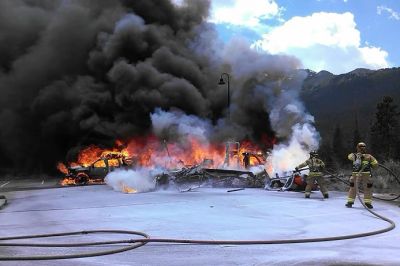
POST-CRASH FIRE WITHOUT CRFS
Frisco, Colorado 2015
Oklahoma City, Oklahoma — 2013
Kingfisher, Oklahoma — 2010

The helicopter crashed shortly after takeoff with a pilot and two flight nurses aboard. The impact forces were survivable for all three occupants, but fuel began spilling immediately after impact and ignited approximately three seconds later. The pilot died, and both flight nurses survived with serious injuries, including severe burn injuries to one of the nurses. The NTSB found that the helicopter's non-crash-resistant fuel system facilitated the fuel-fed post-crash fire and contributed to the severity of the injuries.
Kingfisher, Oklahoma — 2010
Oklahoma City, Oklahoma — 2013
Kingfisher, Oklahoma — 2010
The helicopter crashed with a pilot, flight nurse, and flight paramedic aboard. The pilot and flight nurse died, while the paramedic—who was ejected clear of the post-crash fire zone—survived with serious injuries. The FAA reported that the pilot survived the initial impact with substantial injuries but was unable to escape the fire; his thermal injuries were not survivable.
Oklahoma City, Oklahoma — 2013
Oklahoma City, Oklahoma — 2013
Oklahoma City, Oklahoma — 2013
The helicopter crashed shortly after departure with a pilot, flight nurse, and flight paramedic aboard. The pilot and flight nurse were killed, while the paramedic survived with serious injuries, including severe burns. The fuel tank ruptured during impact and spilled fuel onto hot engine components, igniting immediately. The FAA states that the aircraft was not equipped with CRFS and that CRFS could have decreased the likelihood of a post-crash fire and potentially improved survivability.
CRASHES WITH CRFS INSTALLED
Christmas Valley, Oregon — 2022
Christmas Valley, Oregon — 2022
Christmas Valley, Oregon — 2022
May 18, 2022: N851AL — Airbus AS350B3, AirLink Critical Care Transport.
The air ambulance helicopter encountered strong winds while attempting to land, lost directional control, struck the terrain, rolled onto its side, and sustained substantial damage. The tail boom separated during the accident. The FAA specifically identifies the aircraft as being equipped with CRFS and states that there was no post-crash fire.
Chelsea, Alabama — 2023
Christmas Valley, Oregon — 2022
Christmas Valley, Oregon — 2022
April 2, 2023: N231SH — Airbus EC130 T2, operated by Air Methods/LifeSaver.
This air ambulance crashed onto a roadway during an air-medical mission. The pilot and flight nurse were killed, while the flight paramedic survived with serious injuries. The helicopter sustained substantial impact damage, and investigators documented a small engine fire. Unlike the fuel-fed fires in the non-CRFS examples above, the available investigation records do not describe a ruptured fuel tank producing a widespread post-crash fuel fire.
Lebanon, Tennessee — 2025
Christmas Valley, Oregon — 2022
Lebanon, Tennessee — 2025
November 8, 2025: N107VU — Airbus EC130 T2, operated by Air Methods for Vanderbilt LifeFlight
The Vanderbilt LifeFlight EC130 T2 crashed during an air-medical flight and was substantially damaged. The flight nurse was killed, while the pilot and flight paramedic survived with serious injuries. The NTSB's investigation found that the fuel system remained intact with no apparent fuel escaping from the tanks, and there was no post-impact fire. The investigation remains ongoing, so no final probable cause has yet been issued.
THE CRFS REGULATORY GAP
1994: New Standards, But Not for Existing Designs
On November 2, 1994, the FAA adopted new crash-resistant fuel-system requirements for newly type-certificated helicopters. The requirements were intended to reduce crash-induced fuel leakage and give occupants more time to escape following a survivable crash. However, the rules were not retroactive. Helicopter designs certificated before 1994 could continue to be manufactured without meeting the new CRFS standards. Federal Aviation Administration
The Certification Date Mattered More Than the Manufacturing Date
This created a significant gap. A helicopter could be built many years after 1994 and still not be required to meet the newer fuel-system crashworthiness standards if its underlying type design had been approved before the rule took effect. The AS350 family is a prominent example: later variants continued using an older certification basis, and the FAA specifically documented accidents involving relatively new AS350s that were not required to have CRFS. Federal Aviation Administration
2018: Congress Acted
Congress addressed part of the problem through Section 317 of the FAA Reauthorization Act of 2018, now codified at 49 U.S.C. § 44737. The law extended minimum crash-resistant fuel-system requirements to newly manufactured helicopters regardless of when the original type design was certificated. Federal Aviation Administration
2020: The New Requirement Took Effect
Beginning April 5, 2020, helicopters manufactured after that date generally could not operate in U.S. airspace unless they met the fuel-system crashworthiness requirements established by the 2018 law. NTSB Data
The Remaining Gap
The 2018 law did not require helicopters manufactured before April 5, 2020, under pre-1994 type designs to be retrofitted. Those legacy helicopters may therefore continue operating without CRFS unless an operator voluntarily installs an approved retrofit. The FAA recommends that owners and operators of these aircraft install systems that improve fuel-system crash resistance, but the retrofit is not federally mandated. NTSB Data
WHAT CAN YOU DO?
Contact Your Members of Congress
Federal law closed the manufacturing loophole for newly produced helicopters, but it did not require CRFS retrofits on older helicopters already in service. If you believe Congress should revisit that policy, you can contact the elected officials who represent you and share your views.
Contact Your U.S. Representative
Use the official House of Representatives website to identify your representative and access their contact information.
Contact Your U.S. Senators
Each state has two U.S. senators. The Senate maintains an official directory with links to each senator’s contact information.
Tell Them What Concerns You
You can reference 49 U.S.C. § 44737, explain that helicopters manufactured before April 5, 2020 under older type designs may still operate without a federally mandated CRFS retrofit, and ask your representative or senators to review whether existing aircraft should be subject to additional crashworthiness requirements. NTSB Data
Review the history. Review the evidence. Decide what you believe should happen next—and tell the people who represent you.